Summer 2026: Introduction to Marine Energy
A 3-week short course for rising juniors and seniors at UW Bothell, Seattle, and Tacoma. This course will provide a broad overview of themes relevant to marine energy and introduce students to technical skills relevant to work in marine energy and related ocean applications.
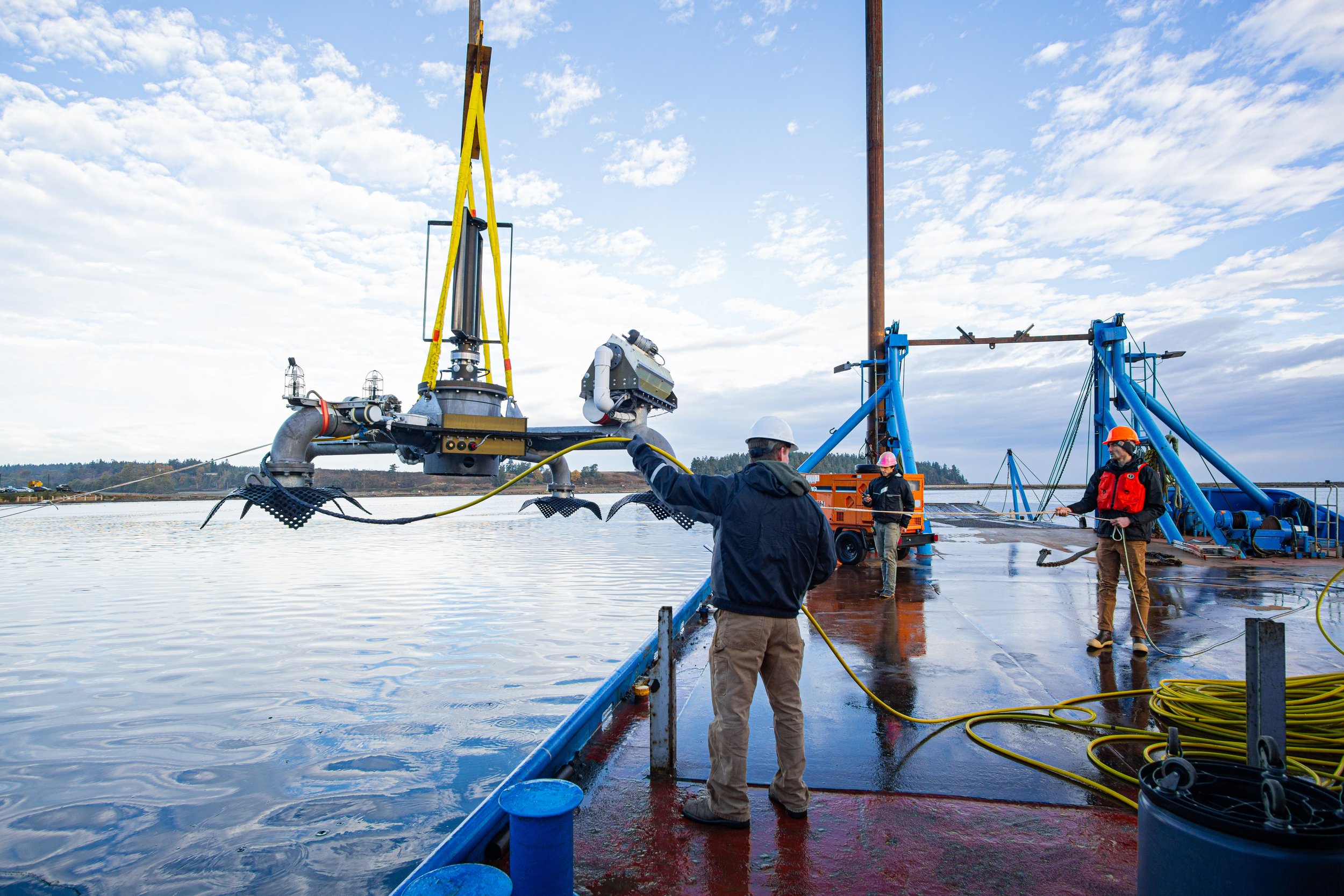
The Turbine Lander, a compact tidal turbine deployed in Sequim Bay, WA. Students in this course will gain hands-on experience with this turbine as well as other tidal and river current turbines at a variety of scales.
Course Description
This course will introduce students to marine energy with a focus on current energy converters (turbines) used in riverine, tidal, and ocean applications. Course content will include key mechanical and electrical concepts, system design and operations, resource assessments for power production, and environmental considerations. Students will explore these themes through a combination of in-person learning and short, asynchronous videos and activities to be reviewed and completed independently.
The hands-on element of the course includes a week of in-person activities at the UW Seattle campus designing for operations at sea, working with field-scale turbine prototypes, testing and analyzing prototype turbines in the laboratory and using a UW research vessel (see photo, below). As part of the experience students will be exposed to a variety of field-going equipment, including mooring components, ocean instrumentation, research vessels, and power electronics designed for ocean applications.
Students will participate in laboratory and field-based testing (R/V Russell Davis Light) in team-based activity. Each team will collect and analyze experimental data and summarize performance findings using axial-flow turbines like commercial wind turbines, but designed for underwater operations.
At the end of the course students will be able to describe the key principles informing system design, measure and present system performance, and integrate the challenges of working at sea into the design process.
Course instructors
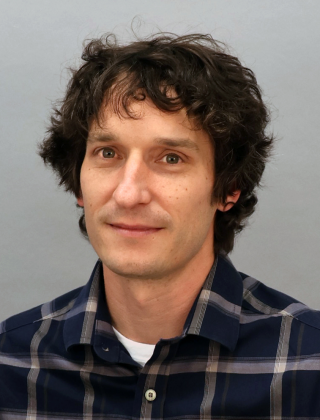
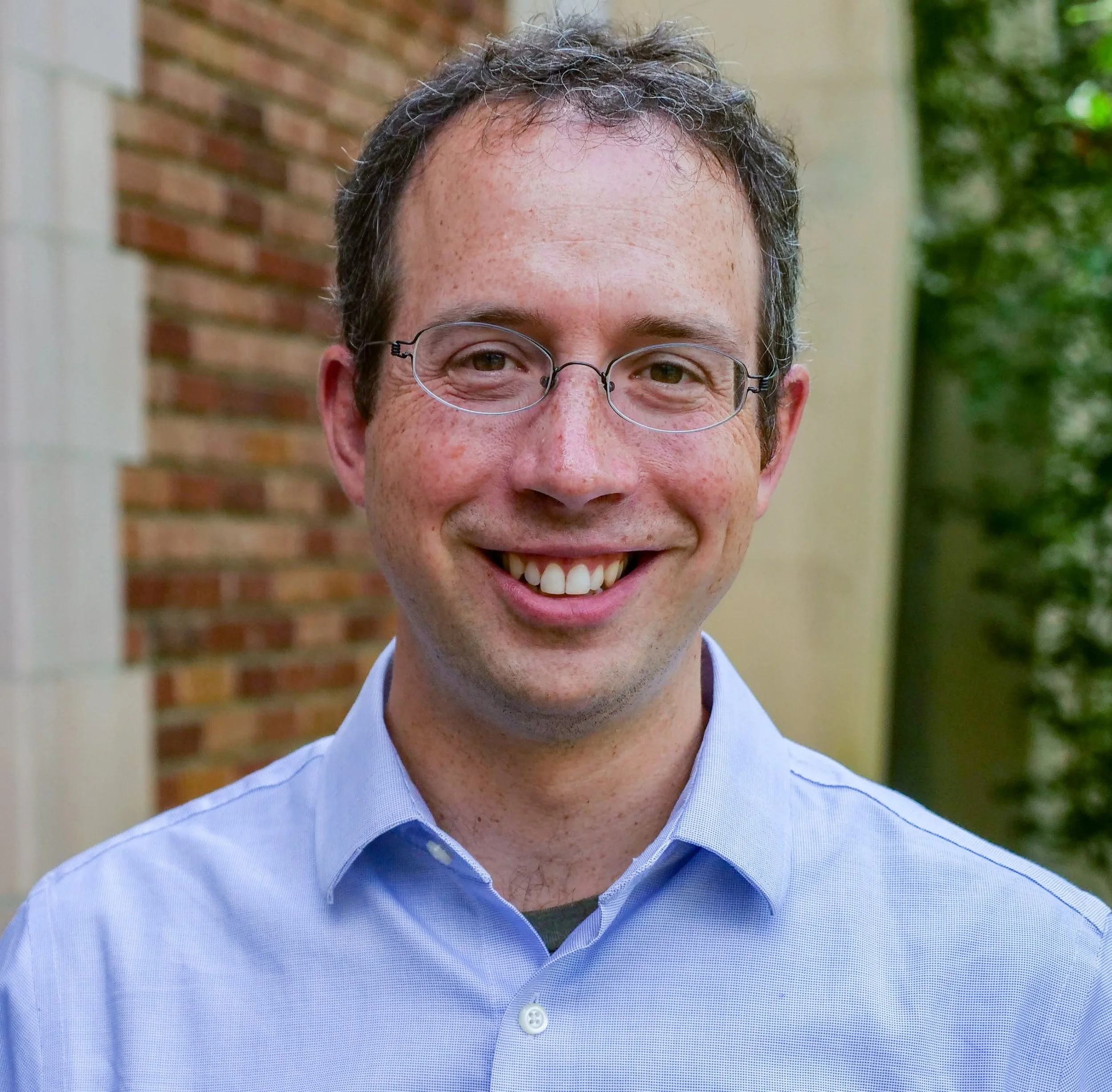
Left to right: Dr. Chris Bassett (UW Seattle), Dr. Brian Polagye (UW Seattle), Dr. Imen Hannachi (UW Bothell), Dr. Heather Dillon (UW Tacoma), Dr. Eli Patten (UW Seattle).

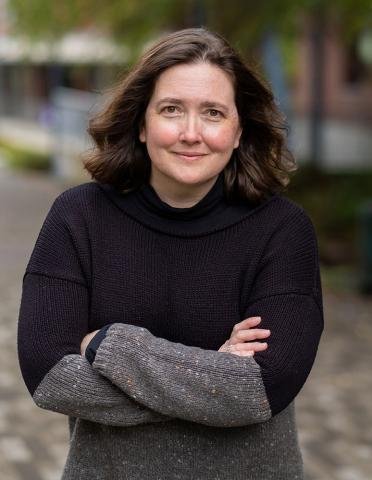
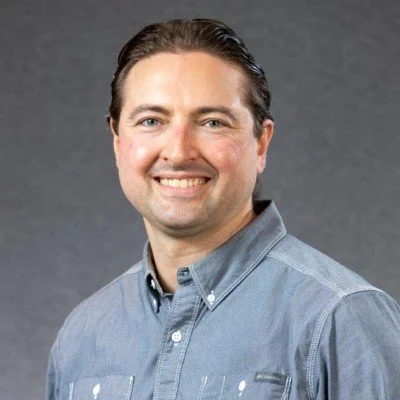
All courses will run with support from research staff and professional ocean, mechanical, and electrical engineers from UW Seattle’s Applied Physics Laboratory.
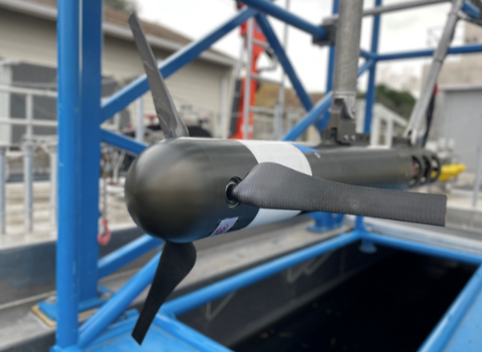
A small-scale axial-flow turbine used at UW for research and development. This prototype will be used in research-vessel based demonstrations during the course.
The Nuts and Bolts:
Dates: August 24th – September 11th, 2026
August 25 - 27: Half-day, person classes at your home campus (UW Tacoma, UW Bothell, or UW Seattle). Timing (morning vs. afternoon) will be determined based on feedback in the application form.
August 31 - Sept 4: Full-day (9am to 5pm) in-person at UW Seattle. Note: Students requiring accommodation in Seattle will be provided with free on-campus (dormitory) housing during the week of activities on the UW Seattle campus.
September 7 - 11: Asynchonous. This week is reserved for completing online modules or project related activities. The anticipated time requirements this final week of the course will be no more than a few hours.
Credit: This is an intensive 2-credit course (TME 499 for UW Tacoma, BME 498 for UW Bothell, or ME 498 for UW Seattle) which will count towards your credit load in autumn quarter 2026. Although you will take the intensive course between summer and fall quarters, it will be reflected on your fall quarter transcript. During the fall quarter students will be required to submit a short reflection on the course.
These credits are tuition bearing. Students who exceed 18 credits in fall quarter will be charged additional tuition. For full information on tuition rates, see [link to https://www.washington.edu/opb/tuition-fees/current-tuition-and-fees-dashboards/undergraduate-tuition-dashboard/]
ME UW Seattle students: These credits do not count towards your full-time requirement for departmental continuation. In autumn, you need to register for 12 additional credits to meet your full-time requirement.
Prerequisites:
There are no specific course perquisites or limitations on admissions, although the course material will focus heavily on content most relevant to mechanical engineers. Data analysis requires the use of Excel, Python, or Matlab and the ability to perform basic calculations (including defining and working with variables, arithmetic, and analytical integration; for those working in Python or Matlab the ability to write simple functions and execute for/while loops is helpful).
Rising juniors and seniors at all three campuses are welcome to apply for enrollment.
Activities:
While at UW activities will take place in several places on campus in addition to a small UW research vessel. Our goal is to maximize participation in as many of these activities across campus and on Lake Washington as possible. We will reach out to students after confirming enrollment to identify necessary accessibility accommodations needed and to identify alternate activities when needed.
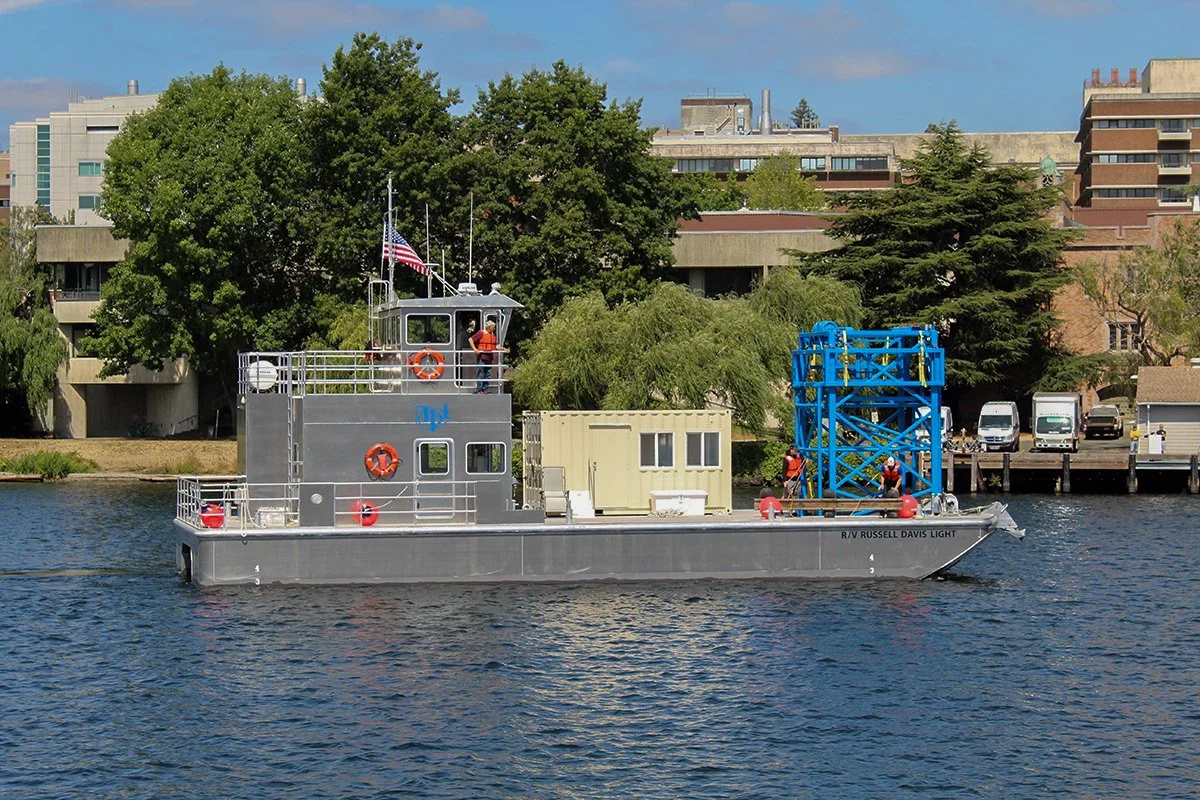
Students will conduct activities on the Russel David Light research vessel (above) at UW’s Applied Physics Laboratory.
Enrollment:
Due to limited capacity the ability to enroll is not guaranteed. Course enrollment is limited to 8 undergraduate students per UW campus. For mechanical engineering students, enrollment priority will be given to students that express an interest in marine energy capstone projects in the 26/27 academic year (options will be available to senior engineering students at all three campuses). At UW Seattle, consideration will also be given to those involved with the WA Wave registered student organization.
- Click Here to Apply -
Applications Due
May 6, 2026, 11:50pm
A resume template for your application is available here, but you’re welcome to use your own instead.
Questions? Please email Chris Bassett: cbassett@uw.edu.